Tuesday, September 11, 2012

Zollverein Coal Mine Industrial Complex

Zollverein was one of the main anthracite coal mines in Germany, running from the mid 1850's until 1986 or so when the steel mills were closing in Germany and so the need for coking coal also disappeared.
For all you amateur chemists out there, the earliest steel was made using charcoal as its heat source. This was fine until the forests began to disappear. Coal was available but its use in steel making was found to be limited as the steel that formed was soft and weak; not exactly the requirement for good steel! Some genius thought ‘why not bake the coal like we used to bake the timber when making charcoal?’ They did and it worked. The chemistry follows the practicality if the solution but by cooking the coal, the result was to drive off many impurities that were then contaminating the steel; Sulphur was the main contaminant. Imagine the 'rotten egg gas' smell that must have come out of the coking plant!!
So any self respecting coking coal source has a mine and coking coal plant in close proximity; on that basis, welcome to Zollverein!
Zollverein's Shaft 12 Winding Tower - once just a symbol of the coal mine but now a symbol of Essen itself
Like Landschaftspark (see the blog from a couple of weeks ago), this is a huge industrial site that has now been converted to a park and other uses, not least being the new Ruhr Museum.
But back at the height of its production, miners were hauling 24,000 tonnes of material per day to the surface. This was cleaned of unwanted rocks and minerals and then hauled across the road to the coking plant. Given these huge sums of material it is not hard to imagine the huge scope and scale of the sites. Topping it all is the mine head for Schaft 12; retained in its original majesty, the mining head is a massive thing of beauty, soaring above the country side. The materials were then sent to the coking coal bunkers; a massive building that looms 40+ metres in the air (providing this sort of view of the surrounding country side).
These bunkers have now been converted to the Ruhr Museum; an amazing museum that runs over three levels winding its way between the original machinery still left in the bunkers. The effect is stunning! A combination of the old and industrial with the new and interactive displays of the museum.
The theme of the museum is a nod to the coal industry, the people from all over Europe who came to work the mines and  the cultures those people brought. There are hints of the natural history of the landscape as well as acknowledgements of the benefits and pitfalls that befall a region like the Ruhr valley that has endured such heavy industry for so very long.
On this day, there was a temporary exhibition celebrating the Krupp family and their legacy. Steel is their legacy and, for a while, that steel saw a lot of action as canons and armaments for Germany in two world wars.

The first Krupp to kick things of in steel bought the patent for crucible steel and gambled his family fortune of the process; sadly he failed to understand just how much capital he would need and died with a loss making business. His wife got things back on track and then her sons and subsequent progeny drove the business to make the Krupp's the wealthiest family in Germany ... eventually.
The road was never easy and their production of armaments made them a special target for reparations after WW1. Mind you, they made good money from the sales of arms. They also tried to argue that they were unfairly targeted by the British in WW2 for bombing as they had diversified their portfolio by then and would argue produced hardly enough to warrant being targeted. Nice try, I think. However, a documentary I watched earlier in the week suggested that once the British developed their strategic bomber command under 'Bomber' Harris, their very first German city targeted was Essen and specifically, the steel works of Krupp.
Apart from armaments, the Krupp clan seem rightly pleased with their work in railways. Tracks obviously but also springs for rolling stock. But their big achievement was the seamless steel wheel for trains. In fact, so proud of this ingenious invention, that Mr. Krupp decided to take three circles (signifying the three seamless wheels) and applied for a trademark in the 1870's for a 3 ring interlocking device to be the Krupp logo.
So an interesting place to visit. You ride the six storey escalator to the mid point of the museum (in the old days, workers simply walked up the conveyors alongside the coal itself). Feel free to poke around there but make the effort and pay the entry price to the museum. If you don't speak German, pay the 4 Euro and make sure you get the audio guide. As ever, there is way more info in the audio guides beyond even the written information in the museum. It makes the museum more clear and the information helps appreciate the history and creates a feeling of place.
A ticket to the museum also gets you access to the roof and that amazing panorama around the factory and Essen's surrounds.
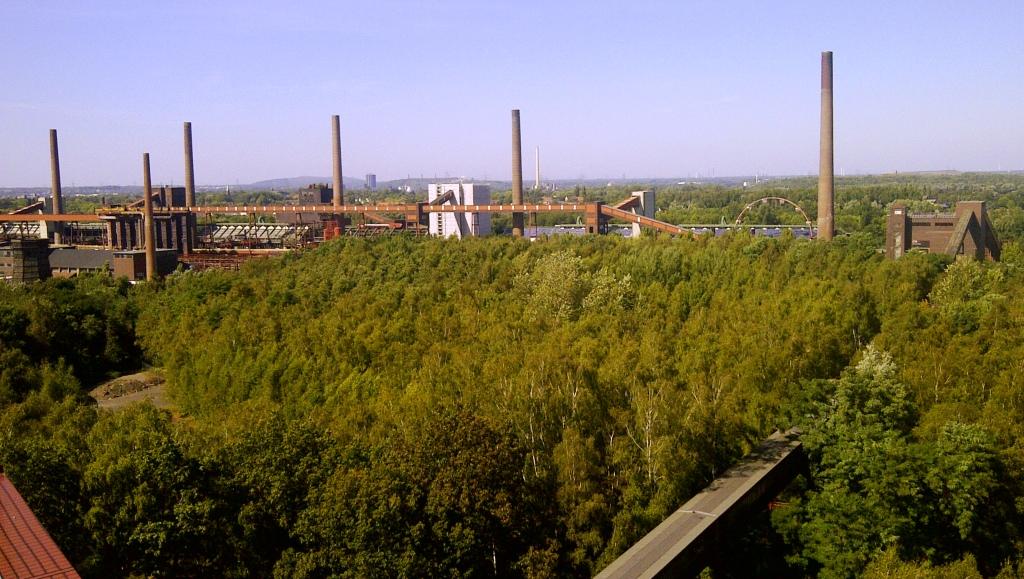
Looking back to the Coking Plant from the roof of the Ruhr Museum at Zollverein
I caught the train to Essen Hbf (central station) and walked the 5k to the site. Easy navigation as well as you simply follow the bike track that's marked with directions to Zollverein. The day was delightful too; mid 20's Celsius and clear blue skies. The walk is pleasant too as it follows the bike path rather than the roads, so it takes you through some nice village settings as well as through some allotments As well. The allotments were filled with noise and laughter today as Esseners were escaping their apartments and enjoying some sun in their garden allotments.
Check out www.zollverein.de. The website is in German but there is an English translation coming soon. The Germans do this industrial transformation so well. Who would have thought of a museum weaving through the heavy conveyors and chutes of coking coal plant? And delivered with such skill and so seamlessly as well. Go along and enjoy the day!

Sunday, September 9, 2012

London's Science Museum

I love the Science Museum in London; it's a curious and eclectic mix of old and new all overlaid with a wonderful geeky vibe. Since our meetings finished early on Friday and I had a few hours to kill, the prospect of spending some at the Science Museum and then walking across Hyde Park to Paddington station to catch the Heathrow Express was just too good to pass up. As luck would have it, I have been re-reading John Gribbin's 'Science - A History'. This is a great read for those who enjoy science as Gribbin brings the scientists to life, painting little vignettes on their lives as he walks us through science from the Renaissance into the 21st Century. How timely then, to have been reading of Newcomen and Watt when to be confronted with their actual machinery sitting in the first hall of the museum. They have even re-created Watt's workshop, right down to the trunk where he kept his son's effects after the little boy died of TB. One thing that really stood out was how long these machines remained in operation. Some of these machines were still running in the 1920's, eighty and hundred years after they were originally manufactured. It's only when you get up close that you realize why this is possible; the strength of construction and the size of the components really defy believe in this modern age of planned obsolescence. They built them to last back in the 1800's, that's for sure! As well, Watt's machines were all low pressure steam as well, so I guess there may well have been less potential for damage. He was quite dismissive of the high pressure boilers as well; I'm sure Watt would have understood the thermodynamics behind the night pressure boilers but he saw them as dangerous and life threatening. Indeed, the museum reports that he felt so strongly that he is quoted as saying Mr. Trevithick 'should be hung' for his designs! Moving into hall two, we makes it space travel. I remember being at school in Melbourne watching the first moon landing. The school was small and had only one television but, since I was one of the prep kids, we were the shortest so we had front row seats. Most of my primary school was spent wishing to be an astronaut and reading everything I could get my hands on about space flight. So this hall is like heaven! Amazing footage of Robert Goddard's early flights with full scale models of his earliest rockets. There is a full scale V2 standing here; Hitler's vengeance weapon would never win him the war but did go on to be the model for the US space program. The exhibit includes actual rockets suspended from the ceiling, satellites (models and real ones), a full scale replica of the lunar module and even a piece of moon rock. Given that there were only 400kg of rock brought back to earth, how neat that the museum has this 51g sample sitting in its glass case. But the piece de resistance has to be the Apollo 10 Command Module sitting slightly on its side with a glass window where the hatch would be. There is something wonderful and terrifying about this machine. How did 3 men live in the cramped spaces for the six days of the journey? The burnt and corroded base and edges of the vehicle remind us how intense the heat of re-entry really is. Does that piece of wiring look a little frayed? Is that because this is now more than40 years old or were they closer to disaster than anyone imagined? With the passing of Neil Armstrong only a week earlier, there is a whole poignancy that I wasn't expecting. I'm standing a metre from a craft that circled the moon in 1969 and it brings a shiver to the spine. Sensational! There was also an Alan Turing exhibition happening at the same time. Google him if you have to, because here is an interesting man and story. A mathematical genius, he came to the fore as a code breaker at Bletchley Park during WW2. He and his team were able to develop the means of breaking the German ENIGMA codes but also developing machines (called 'bombes') that could replicate this process in short order. So you can begin to understand Turing's amazing skills in artificial intelligence and computer design. His life was tragically cut short by his suicide at the age of 41. There are those who believe this was driven by his homosexuality but his mother never believed he was responsible for his own death. The tragedy is that he lived 50 years too soon; his work was years ahead of its time. Almost unbelievably, there are still papers written by Turing that are classified by the British Government. Imagine the progress that has been made in pure mathematics and computer science in the last fifty years and then imagine how far ahead Turing's work must be to have some of his work still classified. Imagine what he could have achieved today with the technology at his disposal and an environment where being gay is no longer illegal. Timing is everything and, in site of his wonderful work in code breaking during the war and the first computers that he built, it feels like we only got a hint of Turing's genius.

Monday, September 3, 2012

Mainz

When catching the train from Frankfurt Airport to Bonn, it's always interesting to see the Roman Theatre that seems to be embedded in the Mainz South railway station. As the train moves through the station, I always wanted to come and look at the theatre and also whatever else there is to see in Mainz. It's around 80 minutes on the train to Mainz so a relatively early start sees me on the train at 8:30 this Sunday morning.
Into Mainz and the first stop is here at Schillerplatz. It's just time for a morning coffee and the day couldn't be better; bright, sunny and the hint of warmth that the breeze will stop from being too hot. Perfect weather and the perfect setting to have a coffee and prepare for the rest of the day.


Schillerplatz is the setting for the annual Fools Day. At 11:11 on November 11 each year the fools will gather in this square and listen to the proclamation announcing the beginning of the fifth season; Carnevale! These are a few days of crazy revelry here in the Rheinland area mainly. The fountain is the Fools' Tower and has a variety of images from history and fantasy. All of this in keeping with the spirit of Fools Day.
The next stop on the tour is the Kupferberg Terrace. The guide claims this is a nice place to sit and admire the view but although we are quite high, the view is dominated by ordinary roof tops and a cityscape reminiscent of downtown anywhere. BUT the aural view is spectacular! From my seat I can spy the tops of at least eight churches and, being Sunday, when midday rolls around the outpouring of pealing bells is an absolute knockout. It was worth the walk here just to listen to the bells.
Climbing a little higher we find one of the original Roman gates to the city.
As you can see, it now seems quite unprepossessing but the part I like is the stone lintel in the main doorway. This would have sealed the gates closed but note how there are two grooves near each end of the lintel; the constant movement of carts over the stones have worn these two grooves. Rome would seem to have been in Mainz for a long time!


Next stop - St. Stephens. A medieval wonder that has been restored since virtual destruction during the Second World War. I am keen to see the Chagall windows but am thwarted by Sunday services. I'll grab a quick lunch and wait for the service to end and head inside.
Now that we're inside - wow! Apparently Chagall completed this work when he was 98 and it was his final piece. But what a final piece! It's amazing how he has been able to bring his own personality (the blue colours are especially striking) yet keep the whole relevant and in keeping with a church originally built in the 13th Century. Such is his achievement. I'm assuming that the windows were destroyed when the church was almost levelled in the Second World War. Such destruction is always a tragedy but at the same time, without that damage we would not have these contemporary yet marvellously beautiful and appropriate windows today. Hats off to those who reached out to Chagall and to the work Chagall has produced.

And hats back on to whoever designed the Internet guide I downloaded! The reading is great but the directions are hopeless. Read the guide but bring your own map is my advice for future Mainz explorers.
Next stop is the Citadel. Again, this was the original Roman camp and has grown until completion in the 17th Century, as part of the fortifications built around the 30 Years’ War. As you can imagine, 1700 years of continuous building means that the walls even today are massive in height and send a message of impenetrability. The gate house is now quite decorous but still feels imposing.

 The original twist in the gate remains so that a battering ram might take out portcullis number one but would never be able to turn and hit the second. Actually, looking at the original space allocated for the outlying portcullis, I'm not sure a battering ram is going to make a lot of impact in the first place.
The other neat thing here is the Drusus Stone.


More an imposing tower at the rear of the site, this monument was erected to one General Drusus, apparently a great tactician but also Emperor Augustus' brother. Killed in benign circumstances (he fell from his horse and died of his injuries) his men were so saddened by his departure that they erected this cairn as a memorial. When I first stumbled on it, I thought this to be a tower from the original part of the citadel. Massive and solid, no wonder it remains impervious to man and the elements after all this time.

Now to my favourite part and the reason for coming to Mainz in the first place.
The Roman Theatre in Mainz with the train line and railway station in the background
The Roman Theatre was discovered in the late 19th Century when Deutsche Bahn (or whatever it was called back then) were carving out a new railway station. On finding this massive theatre, they promptly did nothing but continue to dig and build their station. In fact, apart from naming the station 'Romische Theater' nothing changed. Any damage to the ruins was apparently ok. So little value did the Mainzers place on the location that it was even used as dump to load rubble from the city during the clean up after World War 2. It was only in 1999 that they began to dig seriously - well as seriously as you can with a railway line running through the centre of your dig site! Exposure of the site now reveals a theatre more like a Colosseum than a playhouse. Seating 10,000 spectators, this was the largest Roman theatre north of the Alps. Apparently, the productions were as large in scope as the theatre itself.
The sheer scale of Roman occupation in Mainz is a little mind boggling.
From here I moved to the Museum of Ancient Sea Travel. Within are five Roman ships from the 1-3rd Centuries found when a site was being opened for the second Hilton hotel in Mainz. Being wooden ships, what timbers remain are in surprisingly good condition. Workmen have then created a series of life size replicas of the ships on the basis of the remains. Most of the museum is in German but there is some English translation around but the ships themselves are the story and there is enough to simply absorb and observe here. Given the museum is free to enter the experience is well worth it! What is amazing and surprising is how extensive the Roman fleet’s occupation of the Rhine with its fleet headquartered in Cologne; so far from the sea yet in the midst of the action.
The tour then wends its way back in to the Aldstadt and this is lovely.

Many of the original buildings remain and the winding streets provide more of a labyrinth than sensible navigation. In fact, the street signs are designed to help out a little; the red signs denote streets that point to the river while streets with blue signs run parallel to the river. The rumour is that this was instigated to help soldiers find their way back to their barracks and has remained the format ever since. When this began, no one seems really sure but there have been a few occupying armies through Mainz over the years and not all of them spoke German so maybe there is truth to the rumour.
In the middle of the Altstadt is the Church of Augustin.


Unfortunately we could only look through the glass front doors today so the photos taken didn’t really work but trust me; the paintings that adorn the ceilings are amazing. Even more so when you consider that the church survived the war intact so these ceiling paintings are the originals.

Mainz is a bit of a trip from Bonn but the trip has that magic section of railway where you hug the Rhine from Koblenz to Mainz, passing the Loreley and countless villages and castles nestled into and on top of the cliffs and hills along the river. I'd argue the train ride is worth the effort especially as I'm writing this in the train and we are literally passing the Loreley as I type.
But the city of Mainz is well worth a visit with its Roman heritage bursting out all over the place, those amazing churches pealing their bells on this wonderful Sunday and an Aldstadt that meanders and maintains its old feeling with style and aplomb.

Check out http://www.mainz.de and download the tour guide that suits you best; but be sure to take a map as well.

Monday, August 27, 2012

Landschaftspark - Duisburg Nord

For those following the blog, apologies for the lack of updates recently. I have been enjoying some annual leave as well as some travel for work but I am back and ready to hit the road, rail, footpaths and trails in and around Bonn.
 I am still suffering a little jet lag so thought I might try a longer train ride; today I climbed aboard the RE5 (that's the Regional Express 5 train) and rode the 92km from Bonn to Duisburg. Duisburg is north of Dusseldorf and just inside the North Rhine Westphalia region, so it's a free ride for me with my work issue 'job ticket' or rail pass.

I watched a documentary on places to see in Germany and saw Landschaftspark  (or Landscape Park in English) and was quite entranced. The site was a steel mill from 1901 until the factories were decommissioned in 1985 given the glut of steel caused by over capacity in the European market.

Douglas Adams once wrote that no-one ever uses 'as pretty as an airport' as a metaphor and for good reason. Similarly, I wasn't expecting an old steel mill to be 'pretty'. And it wasn't but there was a stunning, brutal beauty to the place. Firstly the scale is phenomenal. Herr Thyssen began making steel here in 1901 and it seems that he spent the next 85 years perfecting the process and increasing scale with each new blast furnace created.

Your can climb to the top of one of the remaining blast furnaces. With typical German efficiency, each set of stairs is marked with its height above the ground, accurate to the centimeter. I stopped reading the heights once I saw '65.45m'; those of you who are aware of my legendary fear for heights would appreciate my thought process here. However, the view from the top of the tower is breath taking!

This area was one of the main steel making powerhouses for Germany and the level of industrialization surrounding the park is still massive. I walked the 9km from the railway station to the park, hoping to see some beautiful buildings and enjoy the scenery. However, I had forgotten what a pounding this region took from Allied bombing 70 or so years ago. As such, Duisburg has a couple of churches and a beautiful Rathaus or Town Hall remaining but the rest of the city seems to have been built in the last 60 years or so. And these new buildings are functional to the point of being ugly.

But back to Landschaftspark. When you walk in to the park, you follow the old railway lines, now converted to trails for pedestrians and bicycles. Beside the trails remains a functioning railway line and it was quite apropos to be passed by a train weighed down with rolls of steel. Within the park, some of the tracks remain in place but they are now overgrown and provide a nice counterpoint to the train rattling and squeaking past. As you round the corner and head toward the steel mills, it becomes apparent that there were multiple rail lines; coal cars were directed to massive coal bunkers and the railcars were automatically unloaded of their black cargo. Coal was the life blood of the steel making process; the outrageous heat required to smelt the steel required massive amounts of coal. Then, the pig iron was loaded on to separate trains and rolled out on separate tracks.

Following the original coal rails, the bridges over the bunkers remain and have been converted to walking trails so you can walk directly over the coal bunkers and observe exactly how the cars were unloaded. It was from here that I walked over to the blast furnace and climbed to the top of the tower for the amazing views shown above.

But it is at the back of the furnace that you can see what all the fuss was about.

In these images you can see where the iron was drawn off at the base of the furnace and run directly into the channels shown in the picture. Note the tools for taking samples and the like.

Imagine the heat in this area! The walls were only partially bricked, allowing fresh air to wash through but even so. The furnace temperatures got to 2000 degrees C and the steel here is so hot that it flows down these channels to form the ingots. The workers looking at the original ingots thought they looked a little like a pig, hence the name 'pig iron'.

There is a large gasometer here as well, some 15m high and it must be 50m or more in diameter. Originally, this was used to collect gases that came off the steel making process; these gases were then burnt to create electricity that then powered various parts of the plant and surrounding village. Cleverly, this has been converted to a diving tank, replete with sunken ship, plane and a reef. Sadly only divers with reservations could climb up so I have to rely on the website to update you here.

Other buildings have been transformed into offices and the power plant has been opened up to become a concert hall or exhibition space. Exterior buildings have been opened up for a massive series of climbing walls of various levels of challenge.

Kids can try some of the easier ones and enjoy a cool slide that is shaped like one of the massive return tubes in the blast furnace itself. It is completely sealed (except of the two ends, obviously) but that still didn't stop the squeals of delight (or terror?) filling the air.

It's an amazing transformation. Even with the trees softening the exterior of the buildings, it is difficult to make these buildings beautiful. But the effect is most impressive. Steel is obviously a heavy industry so the equipment needed to manufacture steel is correspondingly heavy to the point of appearing over engineered. Everything is designed on a monumental scale in terms of size and structure. Buildings like these are testament to mankind's ingenuity. Walking and clambering around the site, it is difficult to imagine how such a complex yet massive creation could have been conceived, let alone built and maintained. Maybe its a good thing that a campus of buildings like this is kept and transformed in to such a variety of uses; museums, gardens, concert halls, recreational diving, restaurants and the like. But what makes the site work is the open space around the buildings; the slow reveal as you follow the old train lines to the site unveils the buildings slowly and majestically. The quietness of the location is in stark contrast to the maelstrom of noise that must have existed during the days of production.

There is a brutal beauty here. The enormity of the site and it's buildings conspire to create a sense of wonder and amazement. A great place to visit. Check out the website http://www.landschaftspark.de/startseite. For those who don't speak German, click the English flag at the top of the page for a great translation.

Wednesday, July 18, 2012

Kunstmuseum - Bonn


It rained today; perhaps not such a major issue but there was an earnestness about today's rain. It seemed to understand that today was excursion day and that, for the first time since the beyond-freezing-cold of late February, the weather was going to ensure that nothing would be done outside without being terribly and irrevocably inconvenienced.

So I surrendered to those dark clouds and caught the underground to Heussallee and the Kunstmuseum.  This was my first visit to the Bonn's Modern Art Gallery and I have to be honest, I did approach this visit with some trepidation.

In my sad and somewhat Philistine mind set, Modern Art would appear to fall into one of two categories. First, it seems to have been a mistake. I can imagine an artist racing home to tell his partner, 'remember that massive party we had last week and how we spilled paint on a canvas that had fallen on the floor, then we walked and crawled thought the paint? I've been offered a gazillion dollars for it and multiple gazillions if I can produce another twelve. Call everyone back for this weekend and order plenty of bourbon and vodka.'
The second one seems to be an actual confidence trick. As in 'Oh my god! My agent will be here in twenty minutes and I haven't got anything. I know, I'll dribble two blobs of yellow here and then run a six inch wide brush with some black paint on it to give a wide stripe of streaky black between the two yellow blobs.'

Like I said, when it comes to art, I am a Philistine. But at the same time, I have had occasions where art has spoken to me. Like most people, I know what I like. The problem for me today was that I didn't like too much. Perhaps I need help; I did notice several couples sitting and being transported by the setting and the art. They spoke animatedly about form and shape and they gesticulated long and hard as they sat admiring.

I did try but, like Rap music, the art today eluded me.

To top things off, there was a photographic retrospective of Lewis Baltz. Let's not even have the discussion of whether photography is art or not! I did check out his corner of the gallery and was somewhat amazed, to be honest. There were black and white pictures of tract houses and factories, car parks and loading bays from the mid-70's. Having been through a multitude of factories and warehouses in my time, the images could have been eminently forgettable. But Baltz has an ability to frame and capture these mundane scenes beautifully. The black and white images are crisp and clean; almost documentary evidence of an age gone by. The regular shapes of his images become geometrical wonders rather than repetitious images of factory windows and the like.

For good or I'll, it made me look more closely at the streets around my apartment in Bonn. Curiously, I looked and looked again at some of the apartment buildings less than a kilometre from my home in Bonn.
Check out these images (crude by Mr. Baltz standards I know) and see what I saw for the first time in three months.
For example, this looks like just another street in Bonn, right?

But then look more closely at the balconies; Where did these carvings and moldings come from?


These are startlingly beautiful and seem to have just arrived into my state of conscious awareness only this weekend. What sort of mental haze have I been walking around in??


Were they installed in the last couple of weeks? Surely I could not have been walking around so blind as not to see these wondrous items every single day?I walk past many of these buildings every day to catch my tram to the office.


This one exists over a doorway not 500m from my apartment
 
This one has a cheeky face (almost Punch and Judy-esque) on either side of the door
 
 
This magnificent eagle is one of three or four that sit above a small Asian restaurant now
 
After visiting the Baltz exhibit, it was as if a mask had been removed from my eyes. I may not get Modern Art but a visit to the Kunstmuseum has certainly opened my eyes to the beauty around me. Sometimes all you have to do is open your eyes and ears to the opportunity around and life might just astonish you.
Have a great week!

Sunday, July 8, 2012

Burg Nideggen

Today is really a leap in to the unknown. I'm heading to Burg Nideggen on the advice of folks in the office. For me this means three trains and almost two hours and I'm not sure of what the castle will actually look like. The third train is an adventure in its own! A single carriage on a single track where the trees are brushing against the sides of the train. A stream flows by amongst the houses and villages we pas thru. As the train line reduces in clearance and the train loses more and more speed, so the weather closes in. Grey skies with steady rain make a mockery of summer. The one saving grace is that it is not cold but, peering out the window of the train, it does look gloomy.

As we progress toward Nideggen Brucke the stream flows into quite a large lake which looks marvelous! Small boats are moored to local piers near houses; restaurants and pubs are on the shore of the lake. There is no wind so the lake is flat and calm with swans and ducks the only movement on the water. The hills and trees are now moving in again and the lake is gone and the stream has returned. No matter what else today, the scenery promises to be lovely.
For those of us unencumbered by cars, the train is a little circuitous; Bonn to Cologne to Duren to Nigedden Brucke. From there GoogleMaps assure me it's only twenty minute walk to the castle.
As I get off the train, I look up and see the castle at the top of the nearest cliff top.

O boy; it might be 20 minutes but it looks mainly 'up'! The road begins innocuously enough and there's a bridge to cross that stream or should I say 'stream' as the sign on the bridge tells me this is the River Ruhr. There is a fair amount of water here but hardly what I would correlate with the Ruhr; I'm assuming we're well upstream. After crossing the river, the road resolves itself into a series of switchbacks that gently assist the cars to the top. The footpath, however, runs straight up the hill! It crosses the road three or four times but is virtually straight up and pretty hard going.
Once cresting the summit, the work is well worth the effort. The original town seems to dominate the entire top plateau at the top of the cliff. Not far below the surface seems to be a solid layer of rock; ideal for solid foundations for massive fortifications like these.
There must once have been a massive town wall with the standard four gates or tors at each point of the compass. However as we move closer to the inner part of town we find the original gatehouse to the central fortifications.
This is a massive affair where once there would have been two sets of huge doors at each end of the gatehouse. A perfect place to lock in potential n'er do wells while deciding their fate.
From the gatehouse, there must be another 600m of road that was walled on both sides before arriving at two more gates prior to accessing the main buildings themselves. Now, the walls are down and there are lovely views of the surrounding country side and the church. But let's walk on to the main buildings because this is where the real action is.

The original keep has been restored and is now set up as a museum. For three Euro entry, it's well worth the look. Unfortunately there were no English books available today (they're on order apparently but the French, Dutch and German books weren't a lot of use to me) and the museum signs are all in German. But no translations are necessary to check out the armour, weapons, pottery and other display items. Plus the views from the windows are superb.
The museum is not open Mondays but is open for the ret of the week from 10:00-17:00 except for Christmas and some public holidays.
The museum also has a model of the castle with a German commentary but again, the images and background music make it clear that this was a place of structure and delight until destroyed in a siege. The timing of the siege is unclear but cannon were used so it must have been late in the castle's development. Prior to cannon, sieges could be withstood inside the cattle (if all preparation and care was taken) but cannon virtually ended the strategic benefit of castles like Nideggen.
Looking back along the drive to the castle to the double-doored gatehouse

There is a plaque celebrating the castle's 800th birthday 1177-1977; so buildings in this location can claim a long and illustrious lineage.
The castle and its fortifications are made of rosy red stone. It is interesting that a lot of the houses and buildings in and around the town also boast foundations and indeed whole walls of the same red stone. I'm guessing that as the castle and surrounding walls we destroyed, sensible builders were grabbing these beautifully formed and regular shaped stones for their own building projects. A worthy recycling program if ever there was one.

It's only after visiting the museum and then reviewing what remains of the castle do you being to understand what was once here. Those vacant windows were once incorporated into a massive hall that dominated the skyline for miles. So much money and so much power must have been wielded from this location. Time has not been able to erode the feeling of grandeur, the understanding of how complex the design and construction must have been.
The view back to the railway line and Ruhr River merely demonstrate just how immense the site must have been in its hey day.
My recommendation? If you love castles, then pack a book, your iPod and a snack and catch the three trains. The views, the remaining castle/church/fortifications/the museum and the overall immensity of the site are well worth it!

Monday, June 18, 2012

Ahrweiler - Roman Villa – Government Bunker

Actually, I got off the train at Ahrweiler Markt. It is such a lovely day that everyone decided not to ride their bike but simply carry them on the trains in such numbers that no-one can get on or off the train.
Such minor things cannot detract from the day!
Ahrweiler is our location today due to its Roman Villa and Der Regierungsbunker or Government Bunker as well as its silver mine. First things first.
When arrive at Ahrwheiler Markt make sure you actually make it into the town at some stage.

The main square in Ahweiler Markt with the grape vines on the hills behind
Here we find a beautiful walled village where houses are now built right up against what remains of the city walls. There is even a grassed area running around outside the walls, hinting at the ditch that would have existed once. The gatehouses feel authentic; strong and almost vigilant even without a garrison in place. The market square is dominated by the church, open air restaurants and shops. Like Bad Munstereifel, many of the local shops were open on Sunday as well.
It is very easy to find somewhere for a beer or a coffee, for a snack or a full three course lunch. By late afternoon, the crowd had rolled in and there was a real vibe of people and happiness.
But still in the morning, there were few folks about and I thought I'd now head off to the villa.
The villa was found by mistake back in 1980 when road works uncovered some ruins and archaeologists were called in. For me, I think it is the scale of the place that defies belief. A Roman Villa is effectively a mansion with servant quarters, bath houses and space for a family of ten or twenty. Even the  very basics of the hypocaust or under floor heating require special attention to details and smart engineering techniques. Water flows in and through the building. This is clever but must also have brought a feeling of nature and peace with it. The site has to work with nature to allow the water to flow in and through; interesting and pleasant.

The remains are now covered in a massive timber and glass building with a ceiling that vaults the villa, leaving no stone touched but the site completely sealed off from the weather.
The site remains under excavation; being a Sunday, no-one was working today but it would be neat to be a tourist here and watch the archaeologists going about their business.
The quality of the finds is remarkable too. The pottery is complete, the glass shards and nails are plentiful. Occasional glimpses of mosaics and wall paintings hint at how beautiful the place must have been in its heyday.
The site began as a villa, then a bigger villa was built in top of that and then, by the 3rd or 4th Century, it had been converted to a guest house. The excavation has uncovered all stages if these buildings, most interestingly the first house's cool cellar which was filled in to make the second house. I'm not sure where they stored their cold goods in the second house...
The site was destroyed by a landslide in the 5th Century. This is very easy to understand when you see how sheer the nearby hills are. The site remained under all of the landslide material until 1980. Quite amazing!
After a couple of hours puttering about in the villa, I headed up those steep nearby hills to the bunker. It costs 8 Euros to get in and you have to do a tour and the tour is in German (but a written English program is provided and is quite helpful) but even without the English program, this is a must do. Even my generation (now approaching 50 years old) is a little young to have been a part of the Cold War but this place reinforces those times with devastating clarity.
The site was originally a train tunnel but a massive train tunnel; designed for steam trains pulling heavy goods. The tunnel is eight metres in diameter and this is much larger than any comparable tunnel built today. It is long as well; two sections of tunnels that combine for six km length. It worked as a tunnel right through until the end of WW2 when the local French bombed it every 200m to render it useless.
When Germany joined NATO, the rules required they be able to sustain Government in the event of a nuclear attack. A number of sites were reviewed and this one was chosen. The guts of the design centres around that original train tunnel; once it was cleared and sealed. Numerous side tunnels were built but the rules required 80m of rock to provide safety to anyone within. This may not have been enough as the calculations were based on the bomb that hit Hiroshima and by the 60s this bomb was quite small compared to the armaments being constructed by the US and the Soviets. Anyway, these we're the parameters and off they went to build this massive bunker between 1958 and 1970 in compete secrecy.
It's the doors that did my head in. There are so many. The outer doors are 1.2m thick and there are several of them in sequence. Basically, the first 100m of tunnel are designed to be sacrificed if a bomb is dropped. There are series and series of decontamination showers and monitoring equipment to make sure that anyone coming in is not contaminated. The doctors monitoring folks wood do this via windows so as not be contaminated themselves.
The 8m tunnel is high enough to be divided into two floors with offices, laboratories, workshops and the like downstairs with very rudimentary sleeping accommodation upstairs. Dormitory accommodation with four people to a room; very Spartan in design and outlook.
Strangely enough, the design allow for 7,000 people to live in safety after a nuclear blast (assuming that there was no direct hit) for thirty days. But there seemed to be no plan for what happens after 30 days; hopefully the worst of the radioactivity had blown away by then.
During exercises when the site was actually locked down, some people suffered from claustrophobia and were unable to function effectively.
They tested the system every Monday; that must have been something to behold! The alarms would sound, warning lights would flash and those massive doors would slowly but inexorably close, sealing the outside world to its fate.
A little creepy!
Most of the facility has been stripped back to the original tunnel so only the first 200m or so remain with sections of the complex moved into this museum section. One of the neat parts of the tour is to get to where the tunnel opens out and extends away for almost 200m. The echo of sounds here is phenomenal! It seems to reverberate forever. The authorities have had concerts and recitals in this area and it would be inserting to know if this reverb is actually too strong.
As we came out of the bunker and back into the warmth of the sun (I would take a jacket as the tunnels were quite cool), I was about to head back down the hill when I noticed another trail, this one called the Rotweinwanderweg. Having now googled this (check out http://www.ahr-rotweinwanderweg.de/) I now know this is a 35km trail that runs through the wine district of the Ahr Valley of which Ahrweiler is central. The bunker is about 2km from the Ahrweiler itself so I thought I would follow the Rotweinwanderweg back and was rewarded with a view of Ahrweiler like this.

You can see the grape vines in the foreground (and so steep! How do they pick grapes and prune the vines in this terrain). The village itself in the middle and if you look closely you can see the green grass and the cream trail that mark the edges of the city walls. While way off in the distance you can see a ribbon of road suspended by concrete legs; the autobahn to Koblenz.
By following the “red wine wander way” I came out near an abandoned silver mine; abandoned while leaving the skeletal remains of the bridge that was used to haul the treasure trove away. These massive legs are all that are left of this bridge.

If you look closely you might make it out that these legs are now used as climbing walls. Amazingly, this was as far as the bridge's construction went. These massive legs were built but nothing was added to them; the price of silver must have crashed significantly, I guess. It is not difficult to imagine how imperious this bridge might have stood above Ahrwelier below. The sign below shows how the trains would have looked had the bridge been built; the views to Ahweiler Markt are just magnificent!


This was a great day; from 1st Century Roman state of the art living to 20th Century state of the art paranoia buried deep within the heart of the mountains. I think I'll need to come back and explore the Ahr Valley in more detail, especially its wines!